Showing posts with label yeast breads. Show all posts

Monday, March 4, 2013

A Tale Of Two Breads

Crunchy Cornmeal and Semolina Bread

As with many home bakers who experiment with artisan bread baking, I usually have some unusual odds and ends in my kitchen. You know – you buy some of this whole grain or some of that, then you have a little leftover, so you stick it in the freezer to keep it fresh until the next time, and before you know it, three-quarters of the freezer has been overtaken by Ziploc bags of whole wheat flour, flax seed meal, wheat bran, pumpernickel flour, semolina… you get the picture. As someone who has precious little freezer space to begin with (that side-by-side refrigerator with the slender doors for my cramped little kitchen seemed like such a sound idea at the time), I thought it was time to find ways to use up some of the stockpile.

My husband is a big fan of toast. (I am not so much, but I can appreciate a nice lightly browned crunchy-chewy slice of bread schmeared with some nice salty Irish butter.) With his love of toast (and an empty bread shelf) in mind, I decided it was the perfect time to mix up some bread.

Now, confession time. I have a lot of difficulty making sandwich breads. I use the wrong size pans sometimes and often I overproof the loaves. Whatever one can do wrong when making sandwich bread, I apparently do it. I’m a pretty skilled freeform artisan bread baker, but just give me a bread pan and rest assured, it’ll turn out flat, no matter how promising it looks when it goes in (or comes out of) the oven. In spite of this, I gamely attempted a couple of sandwich loaves from the King Arthur Flour site.

The first one I baked was the Crunchy Cornmeal and Semolina Bread. I tried mixing it using the manual method as described because my stand mixer is currently out of commission, and the dough was waaaaaaay too sticky to mix by hand, even with heavily oiled hands. So no, I did not knead it for the full 6 to 8 minutes, but settled for manhandling it until it came together as best as I could, using a bowl scraper and trying not to lose too much dough between my fingers. I omitted the sesame seeds as those were something from my freezer I actually had managed to already use up. The finished loaf was tasty even if it wasn’t as tall as I had envisioned. It toasted up very nicely too!
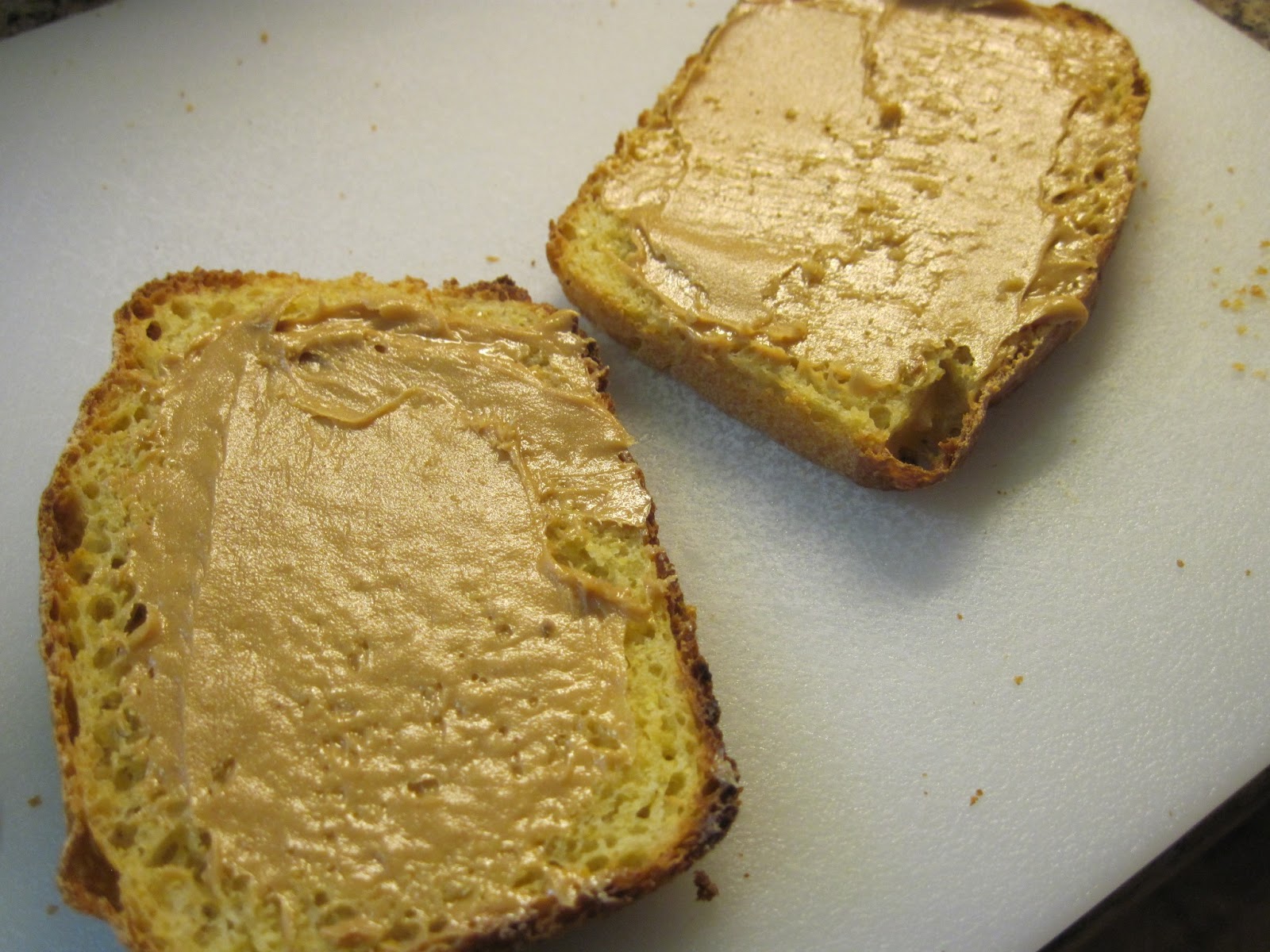
Crunchy Cornmeal and Semolina toast, buttered with peanut butter

The second loaf was the PDQ Onion and Rye Bread. This one was not a yeast bread, but was leavened with chemical leaveners instead – baking soda and baking powder. As you might imagine, the texture was more like a quick bread. The version I used was from The King Arthur Flour’s Baker’s Companion and differs from the recipe on their site slightly. Instead of the Rye Flour Blend and Deli Rye Flavor listed on the site, I used 1 ¾ cups (7 ¾ ounces) of rye flour (from Arrowhead Farms) and ¾ cup (3 ounces) unbleached all-purpose flour. My book calls for 1 ½ teaspoons of salt (rather than 1 teaspoon). I used a slightly smaller amount (2.8 ounces, not 3 ½ ounces as listed in the book) of “Golden Baking Onions” (actually French’s French Fried Onions) because that was the size of the container of onions. The book version has an additional ingredient not listed on the website, which I included: 1 tablespoon of vinegar or dill pickle juice; I used pickle juice. Lastly, the website version instructs you to sprinkle Artisan Bread Topping on top of the loaf. In the book version, you reserve ¼ cup of the French fried onions to sprinkle on top instead. One caveat – the onions don’t adhere very well and end up coming off the loaf when you depan the loaf and when you slice the bread. They also fall down to the bottom of the toaster oven (and burn) when you toast the slices, which is kind of a drag. I would recommend just adding the full amount of onions to the batter. Or if you are really attached to the look of having some of the onions on top (it makes for a pretty loaf, I’ll admit), you can try pushing the onions down into the batter slightly to better embed them and hope for the best.

I thought the onion rye bread was quite tasty, but my darling husband felt it lacked much oniony-ness. If I were to make it again I might add some dried onion flakes to bump up the flavor a bit.

PDQ Onion Rye Bread

Friday, October 8, 2010

Monday, July 5, 2010

revisiting an old favorite


Last summer I discovered a new favorite -- grilling flatbreads.  They are quick and simple to make, and so much fun, and everyone loves to eat them.  Yesterday, I made Grilled Asiago Rounds and Zucchini Caponata from King Arthur Flour's Bakers' Banter.  Both recipes are so easy and sooooo good.  Check out the links above for the recipes as well as how-to videos.

I was outside grilling the breads yesterday morning so we could take them along with us into Boston for the fireworks.  L. said he could smell them in his sleep.  The last time I made this I thought it lasted a bit longer -- maybe a couple of days, but the only reason we didn't finish it all last night was because I only brought two-thirds of the batch of flatbreads and caponata with us.  We had other goodies as well, and really, who needs that much food for just one evening?  I took a lot of abuse for that decision.  Rest assured, we finished the rest of it today. 

Thursday, July 1, 2010

english muffins, hitz-style

I recently finished my first year in the Baking and Pastry Arts program at Johnson and Wales University. Many of the formulas we used in my breads and Viennoiserie classes came from Ciril Hitz's books, Baking Artisan Bread and Baking Artisan Pastries and Breads. Chef Hitz is our department chair at JWU and occasionally teaches in the weekend program (in which I am enrolled). So far, my interactions with him have been limited to relaying messages from him or hitting him up for equipment and/or supplies, including one occasion in which I narrowly missed (by inches!) whacking him in the face with a transfer peel. So unless he's forgotten or he's extremely forgiving, I'm actually pretty happy I haven't had him for an instructor yet. Come to think of it, I'm pretty sure we all look the same in uniform anyway, so it probably doesn't matter.

This English Muffin formula is from Baking Artisan Pastries and Breads. It's different from my previous attempt in that these muffins are baked rather than cooked on the stovetop. The batter is scooped into the muffin rings and proofs on a sheet pan for an hour before they're baked. Unfortunately, I only have four rings, which isn't a problem when you're cooking them the other way because you can only fit four rings in a pan anyway, but it is an issue when you have to proof a dozen at once. I ended up using the four rings, plus the four largest circle cutters from my school knife kit. I know: 4 rings + 4 circle cutters = 8 muffins, not 12. This was not apparent to me even though I was overfilling the molds because I had extra batter. There's a reason all the math I do involves a calculator; I clearly can't even count. At any rate, no serious harm was done, as they turned out fine.

We really enjoyed the chewiness from the multigrain soaker that was added to the batter. Chef Hitz suggests using a packaged seven-grain mixture, but I made my own three-grain combination -- oats, flax seeds and wheat bran -- basically what I could scrounge up from my freezer stash. There's also some white whole wheat flour in the batter for additional nutritional oomph. The crumb wasn't as filled with nooks and crannies as a store-bought muffin, but this might be due to my improvisational molding (and overfilling). I didn't hear anyone complain though!

Friday, May 7, 2010

soft dinner rolls


I'm currently finishing up my next to last class for the school year -- Principles of Artisan Bread Baking. It's the first year class that I had been waiting for all year, and while it's been fun and thoroughly educational, it's also so well within my comfort zone that I haven't felt terribly challenged. Perhaps it's a mental thing -- I'm simply not petrified of failing in this class. However, there's one thing that has me completely stymied: "braiding" dinner rolls. I put that in quotations because it's not really a braid -- it's made from a single strand of dough -- but it's twisted to look like a braid. I've been over it many times and had Chef and more adept classmates show me the technique again and again and I'm confident I'm doing it the same way they are.... it's just that the final product doesn't look quite right to me.

My practical is this Sunday and I know the dinner rolls are one of the products I will be graded on. I have to make a total of three shapes -- the braid, a twist and a dog bone (sort of like a double twist). I'm not concerned about the last two. I made rolls today and practiced the braid. About halfway through the dough I think I may have had a breakthrough but then again, I'm not sure. We'll see on Sunday.

Wednesday, March 3, 2010

classic french bread

Even though I've haven't been posting regularly lately, I do still bake (recreationally speaking) very regularly. My hard drive is chock full of photos of baked goods, but I can't find the time to blog any of it. However, JWU will be out for the summer in 12 short weeks and rest assured, I plan to resume my regular posting.

One of the things I've been making regularly at home has been bread. My go-to bread lately is the Classic French Bread from Peter Reinhart's most excellent Artisan Breads Every Day (and I'm not just saying that because he thanks me -- and over 500 other people -- on page 215) -- it's just a straightforward, tasty, really consistent recipe. What I love most about it is that with a little bit of planning and very little fuss, we can have quality bread with dinner. Peter's method in this book is to mix the dough the day (or a few days) before you intend to bake. You then refrigerate the dough overnight (or up to 4 days). While the dough is in the fridge, the flavor develops and deepens. On baking day, you shape the loaves, then proof and bake. It really produces some of the best bread we've ever eaten.

Tuesday, February 2, 2010

scali rolls


I made these the other day when I needed something bready to go with the chicken chili I was making. The recipe is from Bakers' Banter, and looked like something I've made a number of times before. Unfortunately, as it so often happens these days, I didn't manage my time very wisely and when it came time to braid and divide the dough, I was scrambling. I haven't braided dough lately and couldn't quite remember how best to go about it and then I kind of hacked the braided loaves into irregular lengths. Oh well. They were still tasty.

Friday, October 9, 2009

another friday, another french boule

This is to accompany tonight's dinner -- homemade Potato Ham Soup. I made the bread from Peter Reinhart's Classic Boule recipe.

Tuesday, October 6, 2009

artisan boules

For the past few weeks we've been having homemade soup and home-baked breads for dinner on Friday nights. It's perfect for those evenings when the four of us aren't able to all sit down to eat at the same time. Here are a couple of boules I made from the master recipe in Artisan Breads in Five Minutes a Day.

Saturday, August 29, 2009

garlic grilled bread and eggplant caponata


More grilled bread, more caponata! I made this to take along on our trip west to see James Taylor at Tanglewood (the summer home of the Boston Symphony Orchestra), although we ended up eating much of it at home the next day since it poured the evening of the concert and it was difficult to handle a large golf umbrella and a glass of wine and bread and caponata all at once.

Like the earlier grilled bread and caponata, these recipes were from King Arthur Flour's Bakers' Banter. This dough was made with garlic-infused olive oil and contained no cheese. It also had a higher ratio of semolina to flour which gave it more of a pita bread (without the pocket) texture -- chewier and less soft than the Asiago bread. Sadly, the garlic flavor was so subtle as to be barely discernible. I wasn't crazy about this bread and found myself wishing for the Grilled Asiago Rounds.

The eggplant caponata was very like the zucchini caponata I made before, just with eggplant instead of zucchini. The chunks were a little less defined (mushier) than in the zucchini caponata -- just a little different but still very tasty.

Friday, August 14, 2009

grilled asiago rounds and zucchini caponata

I made these grilled flatbreads outside yesterday during one of the drizzliest days we've experienced this summer. Not really how I planned it, but whaddya gonna do?


The recipe is from King Arthur Flour's excellent blog, Bakers' Banter. It's not my first try at grilled bread, but it's definitely my most successful. What's better than moist cheesy bread, hot off the grill? Everyone raved about it! And it was so simple to make -- definitely going to make this one again this weekend. Alongside the bread, I served this Zucchini Caponata. The basil was from our garden -- it was fragrant and fresh tasting and we were happy to get to enjoy some of it before the bugs ate all of our basil plants to the ground.

Sunday, July 19, 2009

bread baker's apprentice's white sandwich bread

We're staycationing this week and (this is really unrelated) we've been trying to eat down our fridge and pantry (and stay out of grocery stores). We ran out of bread (all those sandwiches we've been making for our beach days!) and so I whipped up the white bread (variation 1 for those of you with the book) from The Bread Baker's Apprentice. I was super-diligent this time and kept a close eye on the bread so that it did not overproof. Still, the loaves were not super tall -- I was expecting more oven-spring -- but they were a beautiful golden-brown and had a rich buttery flavor. This morning P. made fried egg sandwiches (with cheese and bacon) on toast from this bread. Yum! :-)

Monday, July 13, 2009

damn the anadama

The story goes that Anadama Bread was created when a crusty old New Englander came home after a long day's work to discover his wife Anna had run off and all that was left for his dinner was a pot of cornmeal mush and molasses. He tossed some flour and yeast into the slurry and baked it, cursing "Anna, damn 'er!" ("Anadama" to non-Yankee ears) all the while.

This is my first try at Anadama Bread (from The Bread Baker's Apprentice) -- I decided to give it a whirl after hearing great things about the results from BBA Challenge participants. Alas, I overproofed my loaves and they turned out rather sunken and flat. I can't win sometimes -- either my kitchen is too cold or too warm, depending on the season. I'm sure the Anadama will be great for our sandwiches today, though. Our crazy New England weather has finally cleared up after weeks of rain, so we're heading to the beach!

Monday, July 6, 2009

monday morning bagels

Do you want to know a secret? Homemade bagels are crazy easy to make. They're even easier than baking a batch of muffins (although they do require a wee bit of planning) and are far more impressive in my opinion. I baked this batch from Peter Reinhart's wonderful Bread Baker's Apprentice and topped them with a blend of coarse kosher salt, poppy seeds and toasted sesame seeds.

Sunday, July 5, 2009

garlic bread sticks

C. is a huge devotee of garlic bread sticks. And as a result, we've sampled many different recipes. Actually, I guess we're all fans, because we have a tendency to turn almost any individually sized baked good into some sort of garlic bread stick variation -- garlic pretzels, garlic biscuits, garlic knot rolls.

I bookmarked this recipe for the Bakers' Banter's Soft Bread Sticks a couple months ago. They compare them to Pizza Hut's bread sticks, which I've never had, but if these bread sticks are any indication, they must be very tasty. This recipe is a variation of BB's Blitz Bread (which I made last summer). The texture of the bread sticks is reminiscent of a focaccia, but unlike a traditional focaccia, these are super fast and super easy to make -- from start to finish in just a couple of hours. The bread sticks are light and have a little crustiness to them, thanks to a second turn in the oven, and are rather addictive. I actually baked them for C. to take to camp for lunch tomorrow but we couldn't help sneaking several. But no worries -- the recipe makes 3 dozen!

Friday, June 12, 2009

san francisco-style sourdough bread


I fed my sourdough starter last week (over six months along now and still alive and well!) and made a couple boules of San Francisco-style sourdough bread. I wasn't sure what being a "San Francisco-style sourdough" meant exactly, so I did a little research.

According to Peter Reinhart's Crust and Crumb: Master Formulas For Serious Bread Bakers:
What makes this a San Francisco-style bread is a sour rather than mild starter, a wet rather than firm mother sponge (as in pain au levain), and an intermediate "build." Using both wet and firm starters develops a more rounded flavor. You could make a dough directly from the barm sponge but it will be slacker and spread out rather than up. It also won't have as much complexity of flavor. The firm starter makes a big difference; it allows you to step beyond good bread to incredible bread.
And incredible bread it is. In the past 3 days, we've had it just about every way you can imagine, including countless grilled cheeses (made with jalapeño jack cheese -- so good). In fact, as I type, another batch is proofing... :-)

Saturday, June 6, 2009

easy cinnamon bread

Last holiday season I picked up a bag of Hershey's Cinnamon Chips (a seasonal offering in these parts) with this bread in mind. I'm embarrassed to report that it has taken me until now to get around to baking it. In any event, King Arthur Flour's Easy Cinnamon Bread is a quirky little offering. Part yeast bread and part quick bread, it tastes like a not-too-sweet cinnamon coffee cake. The cinnamon chips are interesting too -- I thought they'd be intense pellets of pure cinnamon flavor, but they are more like cinnamon-tinged butterscotch chips and lend pleasing bursts of spicy ooey-gooey goodness to the bread. I highly recommend having a thick slice, preferably toasted and buttered, alongside your morning coffee.

Monday, June 1, 2009

portuguese sweet rolls

Except for the odd grilled cheese or (plain) pasta day, C.'s not a school lunch kind of kid. And I fear I've spoiled him by having fresh baked goods at the ready. In the past, he'd often take a few pieces of baguette or sometimes these garlic and cheese biscuits (easy to make in a jiffy), but since he's gotten his palate expander, crustier breads are off limits and I've been on a quest to find something more appropriate.

I baked him some Portuguese Sweet Rolls for this week's lunch. I omitted the lemon oil because I didn't think that would fly with him, and the vanilla as well, because I didn't remember tasting vanilla in the rolls I've had before. Per the instructions, I baked them in two 9" round pans. After proofing and baking, they had puffed up to the point that they touched, so they have flat sides. In spite of rotating the pans and tenting them with foil mid-bake, the tops browned a bit unevenly and the bottoms browned a lot more than I would've liked (I'm thinking this is due to the higher fat and sugar content). C. didn't care -- he was pleased as punch!

After shaping the rolls.

Cooling after baking.

Thursday, May 28, 2009

pain d'epi


In the spirit of such Internet bake-alongs as Tuesdays with Dorie and The Daring Bakers, a group of ambitious baking bloggers recently started The BBA Challenge, in which they are baking every recipe from The Bread Baker's Apprentice by Peter Reinhart. Such a challenge very much intrigued me because I am, at the core, a bread baking devotee, but I was reluctant to participate because I've been feeling kind of overwhelmed by my dwindling time as a full-time at-home parent, particularly with the kids' summer vacation coming up. Then I remembered that I recently completed my very own "bake Peter Reinhart's entire book" challenge, baking from his upcoming Peter Reinhart's Artisan Breads Every Day, for which I was a tester (one of 500 or so!) for 6 months.

During the course of the testing, I purchased Artisan Breads in Five Minutes a Day by Jeff Hertzberg and Zoe Francois, but never found a moment to bake from it before now. So earlier this week I baked the Pain d'Epi (Wheat Stalk Bread), which I selected because (a) I've never made Pain d'Epi before and (b) it was one of the recipes in the book that used bread flour (which was all I had in large quantities in the house at the time). Each recipe in the book makes enough dough for a few loaves -- the idea being that you mix up a large batch and retard it in the fridge until you are ready to make some. You can then lop off a hunk and bake a loaf at a time, saving the remainder for another day.

As this was my first attempt at baking from the book, I haven't yet gotten the technique down. It's actually really simple... maybe too simple for me. I'm not used to being so carefree with my bread baking and I actually like fussing over and kneading the dough. Artisan Breads in Five Minutes a Day is relatively freewheeling in that regard. I like very precise instructions (which is why I love Peter Reinhart so much, I guess). I also live and die by my kitchen scale. Artisan Breads in Five Minutes a Day measures ingredients by volume rather than weight and refers to dough sizes as "a grapefruit-sized" or "cantaloupe-sized." I suppose this makes it very beginner-friendly and low on intimidation, but it's not a natural fit for me.

My Pain d'Epi (four separate loaves) varied a lot. Generally I would say the 30 minute final proofing was inadequate -- my loaves barely rose. I should've gone with my gut and proofed them longer. Also -- something odd -- the bread was really salty. The recipe called for 1 1/2 tablespoons of salt for a 4-pound batch of dough. I didn't question this but the resulting saltiness was overwhelming. My salt-loving 11-year-old even pronounced it "too salty to eat." I noticed that another recipe in the book (the master recipe) calls for 1 1/2 tablespoons of kosher or coarse salt, which would actually be less salt (if measured by weight) than 1 1/2 tablespoons of table salt. I'm wondering if that was a detail that got lost somewhere?

Anyway, next up from Artisan Breads in Five Minutes a Day -- I'm going to go back to the beginning and make the master recipe. I'll let you know how it turns out.

Thursday, May 14, 2009

the easiest whole-wheat bread ever?

I was really intrigued by this recipe from King Arthur Flour Whole Grains Baking. The dough isn't kneaded; rather the ingredients are mixed into a batter which is proofed in a loaf pan for an hour and then baked. The instructions seemed so avant garde -- when have I ever gone from mixing ingredients to oven-ready loaf in just an hour?! I suppose I shouldn't have been surprised that it turned out kind of... ummm... flat. I later found the recipe posted on King Arthur Flour's site (renamed "No-Knead 100% Whole Wheat Bread"), now with more extensive proofing instructions. Apparently, I should have let if proof slightly longer, although I doubt another 30 minutes would have made much of a difference -- my bread barely rose at all in 60 minutes (this was as expected, according to the book instructions). If only I had done a little more research -- but sometimes I just want to bake without overthinking things, ya know?

Appearances aside, the bread is soft and moist, and the flavor of the molasses really shines. It toasts up beautifully too!
Older Posts Home